
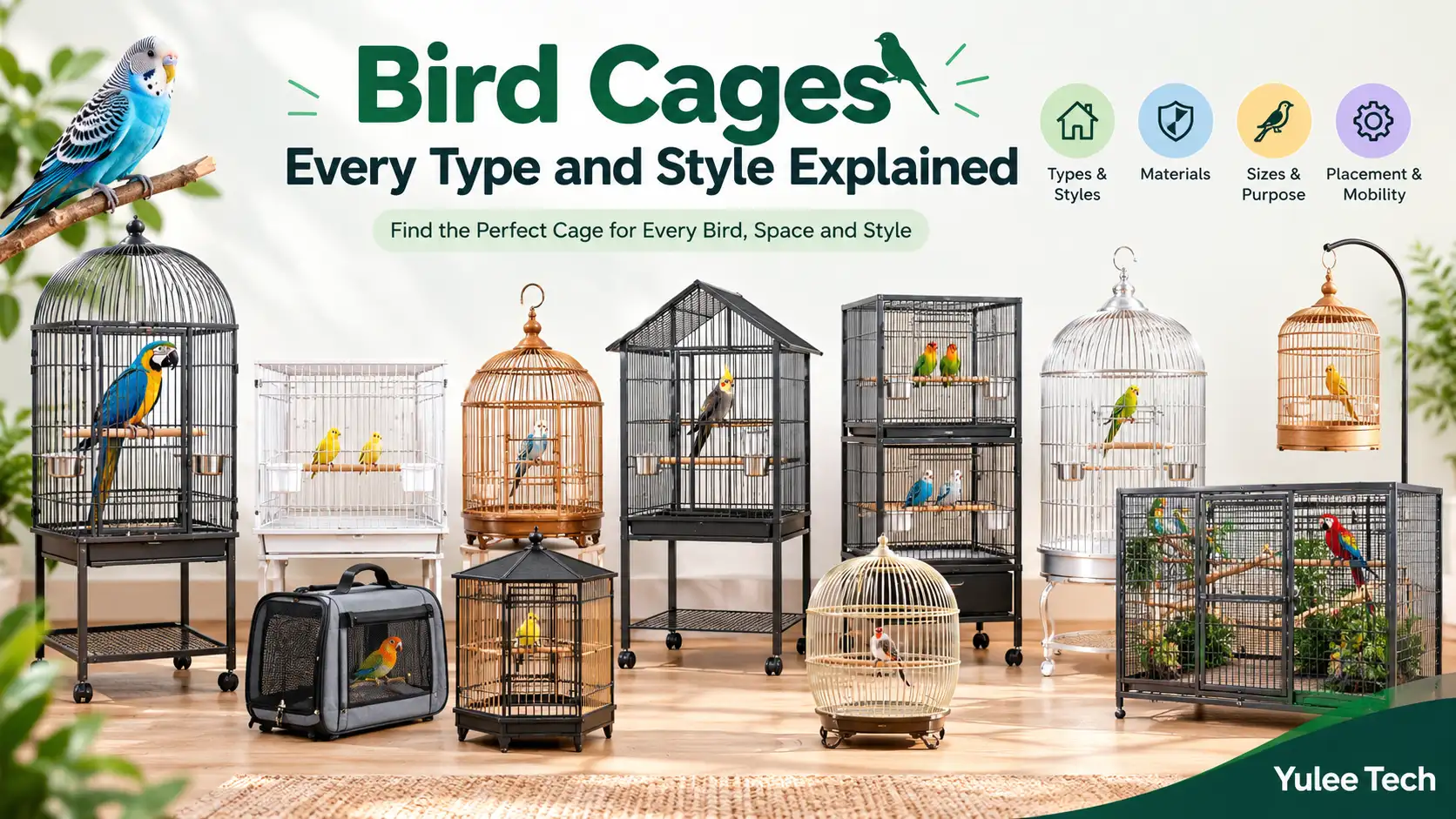
A bird cage is a metal, wooden, or acrylic enclosure that keeps a pet bird safe while giving it a place to eat, sleep, perch, and play. Most cages combine a frame of bars, a base tray that catches droppings, doors for access, and cups or holders for food and water. That simple description covers a surprisingly wide range of products. A cage for two finches looks nothing like a cage for a large macaw, and a travel carrier serves a completely different purpose than a permanent home.
This variety explains why shoppers often feel confused when they first look at bird cages. The same product category includes flat top, dome top, and play top styles, tabletop and floor-standing models, steel and wooden builds, and everything from a small hanging cage to a walk-in aviary. This guide explains every major type, group by group, so the differences become clear and each style makes sense on its own.
What Is a Bird Cage?
A bird cage is the main living space for a pet bird. It protects the bird from household dangers, keeps it from flying away, and gives it a fixed place to rest, eat, and sleep. A good cage also gives the bird enough room to move, stretch its wings, and use perches and toys. The cage does not replace time outside the cage, but it works as the safe home base the bird returns to every day.
Every cage is built from the same basic parts, even though the shapes differ widely.
- Frame and bars. The frame holds the cage together, and the bars form the walls. Bars are usually made of steel or iron, and the spacing between them changes with the size of the bird.
- Base tray and grate. The tray sits at the bottom and catches droppings, seed, and feathers. Many cages add a grate above the tray so the bird cannot walk on the waste.
- Doors. The main door lets the owner reach inside. Many cages also have smaller feeder doors, which let the owner refill food and water without opening the main door.
- Perches. Perches give the bird a place to stand and rest. Most cages include at least one, and owners often add more.
- Food and water cups. These sit in holders attached to the bars or the feeder doors.
- Stand or base. Some cages come with a stand, and some sit on a table. The stand lifts the cage to a comfortable height and sometimes adds wheels or storage.
The shape, size, roof, and material of these parts create the many types explained below.
How Bird Cages Are Classified
Bird cages do not follow one official list of types. Sellers, breeders, and bird keepers describe cages in several different ways, and each way highlights a different feature. This guide uses five groups so that every common type has a clear place.
- Roof style. This looks at the shape of the top of the cage, such as flat, domed, or pointed.
- Size and purpose. This looks at what the cage is built to do, such as housing one bird, allowing flight, supporting breeding, or travel.
- Placement and mobility. This looks at where the cage sits and whether it moves, such as on a table, on the floor, or on wheels.
- Material. This looks at what the cage is made from, such as steel, wood, or acrylic.
- Bird size. This looks at which birds the cage suits, from small finches to large parrots.
One cage often belongs to several groups at the same time. A single product might be a wrought iron, dome top, floor-standing cage built for a conure. Reading about each group separately makes that kind of description easy to understand.
1. Bird Cages by Roof Style
The roof is the easiest feature to see, and it changes how the cage looks, how much headroom the bird has, and what the owner can do with the top of the cage. Birds like to be up high, so they tend to climb to the top of the cage whatever the roof shape. The roof style mostly changes the space inside and the convenience for the owner.
1.1 Flat Top Bird Cages
A flat top cage has a level, horizontal roof. The cage looks like a clean rectangle, and nothing rises above the top bars. This is the simplest roof shape, and it appears on many tabletop and floor-standing cages.
The flat roof keeps the cage compact in height. That helps in rooms with low ceilings, and it lets the cage fit under a shelf or beside furniture. Owners also use the flat roof as a surface for a small perch, a toy, or a separate play stand. The tradeoff is headroom. A flat top gives the bird less vertical space in the middle of the cage than a dome or pointed roof does, so it suits birds that spend more time perched across the cage than climbing upward.
1.2 Play Top Bird Cages
A play top cage combines a flat roof with a built-in play area. The play area usually includes perches, ladders, hooks for toys, and cups for food or treats. In effect, the cage works as a home and a play station in one product.
The play top lets the bird leave the cage and stay close to the family without flying around the room. Many owners like it for a cage that sits in a busy part of the house, because the bird can climb to the top and watch what happens. A tray or grate under the play area usually catches droppings, so the owner cleans the top as well as the bottom. Birds enjoy sitting on top of any cage, so the play top is mostly a convenience for the owner. It becomes most useful for birds that spend a lot of time outside the cage.
1.3 Dome Top Bird Cages
A dome top cage has a curved roof that rises toward the center. The curve adds headroom in the middle of the cage without making the cage wider or deeper. That gives the bird more room to climb, stretch, and hang from the roof, while the cage keeps the same footprint on the floor.
The curved shape also gives the cage a more decorative look, which many owners prefer in a living room. Victorian and Napoleon top cages belong to this group. These styles use ornate curves and often add doors on the top of the cage, which give the bird a second exit besides the front door. Some dome top cages open fully at the top and add a drop-down landing door in front. A top-opening design can make it harder to hang toys from the roof, so owners should think about how they plan to arrange the inside.
1.4 Pointed Top Bird Cages
A pointed top cage has a roof that rises to a peak, like the roof of a small house. Two sloped sides meet at a ridge, and that shape adds vertical space and a decorative look at the same time. Many pointed top cages resemble small houses or gazebos, and they often appear in wrought iron.
The difference between a pointed top and a dome top comes from the line of the roof. A dome uses one smooth curve, while a pointed top uses straight sloped sides that meet at a point. Both add headroom, and the choice mostly depends on the look the owner wants. A pointed roof gives the highest point at the center, so a bird that likes to climb gets a tall perch spot near the middle.
1.5 Round Top Bird Cages
A round top cage uses a smooth, arched roof that curves from one side of the cage to the other. The arch sits between a flat top and a full dome in height. It adds some headroom, and it avoids sharp corners at the top of the cage.
Cage makers do not always use the same words for roof shapes. Some sellers call a rounded roof a round top, and others call the same shape a dome top. Because the names overlap, a shopper should check the listed height and the shape in the photos instead of relying on the name alone.
1.6 Canopy Top Bird Cages
A canopy top cage has a roof that slopes up and out from the sides, much like a tent or an awning. This style usually appears on large, roomy cages. It gives the cage a grand look and adds space above the bird.
Some sellers also use the word canopy for any big cage built taller and wider than a standard model. These cages often hold several birds or one large bird, and many sit on rolling stands. As with round tops, the term varies between sellers, so the description and dimensions give a clearer picture than the name.
2. Bird Cages by Size and Purpose
This group looks at what the cage is built to do. Some cages serve as everyday homes, some give extra room for flying, some support breeding, and some exist only for travel. The sections below explain each purpose and the kind of bird it fits.
2.1 Standard (Starter) Bird Cages
A standard cage is the basic rectangular cage that most people picture when they think of a bird cage. It has a moderate size, a simple frame, a few perches, food cups, and a tray. Sellers often package these cages as starter kits that include perches, cups, and sometimes a few toys.
Standard cages suit one bird or a pair of small birds, such as budgies, finches, canaries, or cockatiels. They give the bird a safe home and enough room to move around, but they do not allow real flight. Birds in a standard cage need regular time outside the cage to stretch their wings and get exercise. The model works well for first-time owners because the design is simple and easy to understand.
2.2 Flight Cages
A flight cage is a wide, long cage built to give birds room to fly. Birds fly horizontally, from one side to the other, so a flight cage focuses on length and width instead of height. A bird can move between perches at opposite ends of the cage and use its wings in short flights.
Flight cages suit small active birds, such as finches, canaries, budgies, and lovebirds. They also work well for groups of small birds, because several birds can share the space and fly without crowding each other. Many flight cages have wide front doors, removable grates, and stands with wheels. Most flight cages stay indoors, and some models suit outdoor use. A flight cage takes up more floor space than a standard cage, so the owner should measure the room before choosing one.
2.3 Double Flight and Double-Stack Cages
A double flight cage is a very large, long cage with two compartments. The two sections sit side by side, and a divider separates them. The owner can keep two groups of birds apart, or remove the divider to create one very large space. Double flight cages use strong, long-lasting materials because of their size, and they suit homes with many birds. Wildlife rescue and rehabilitation centers also use cages of this kind.
A double-stack cage solves the same problem in a different way. Two separate cages sit one on top of the other, and each has its own tray and doors. This design uses vertical space instead of floor space, which helps in smaller rooms. Other variations include double dome top and double play top cages, where each section has its own roof style.
2.4 Breeder, Stackable, and Divided Cages
A breeder cage is built for people who breed small birds. Most breeder cages have two compartments separated by a removable divider. The divider keeps two birds apart until the owner decides to introduce them, and the owner can remove it when the birds are ready to pair. Breeder cages often include an opening or a mount for a nest box.
Many breeder cages are also stackable. The owner places one cage on top of another to create a bank of cages in a small area, and each cage keeps its own tray. Some models work as a 2-in-1 convertible cage. The owner can split the cage into two small homes with the divider in place, or remove the divider and use the cage as one large home. That flexibility helps owners whose needs change over time.
2.5 Corner Bird Cages
A corner cage has an angled or cut side so that it fits snugly into the corner of a room. The design uses space that would otherwise stay empty, which makes it a practical choice for small rooms or crowded apartments. Corner cages often have a curved or angled front, and many also include a play top.
The shape gives the bird a decent amount of interior room while taking a smaller share of the usable floor in the room. A corner cage works for many kinds of birds, depending on its size, and larger versions suit medium parrots. Owners should check the interior dimensions, because the angled side can reduce the usable space compared with a full rectangular cage of the same outside size.
2.6 Hexagonal Bird Cages
A hexagonal cage has six sides instead of four. The shape gives the cage a decorative, rounded appearance, and many hexagonal cages add a peaked roof that gives the bird extra vertical space. Large versions often stand on rolling stands and suit medium birds that like to climb.
The six-sided design lets the bird look out in many directions, and it lets the owner see the bird from many angles. The cage looks more like a piece of furniture than a basic box. The interior has fewer straight runs than a rectangular flight cage, so it suits climbing and perching more than long flights.
2.7 Round Bird Cages
A round cage has a circular footprint, and the bars curve around the bird. These cages are usually small and decorative. They often sit on a table or hang from a hook, and they suit small birds such as finches and canaries.
A round cage has no corners, and the curved wall gives it a soft, classic appearance. The curve reduces the length of a straight flight path, so the bird has less room for longer flights than it would have in a rectangular flight cage. Owners should arrange perches carefully so the bird can move around the interior without bumping into the sides.
2.8 Travel and Carrier Cages
A travel or carrier cage is a small, light cage built to move a bird from one place to another. Owners use it for vet visits, short trips, house moves, and taking a bird outside safely. Travel cages come in several designs. Some are carrier backpacks with a built-in perch, and some are metal cages with a handle. Collapsible or folding models pack down flat for storage when the owner does not need them.
A travel cage keeps the bird secure and calm during a trip, but it does not give enough room for everyday living. The bird should return to its main cage after the trip. Show cages belong to this group as well. They are small, plain cages used at bird exhibitions for judging, and they usually follow uniform show rules. Breeders of canaries, finches, and budgies use them for competitions, and they do not serve as everyday housing.
2.9 Hanging Bird Cages
A hanging cage hangs from a hook, a bracket, or a hanging stand instead of resting on a surface. These cages are usually small to medium in size, and they suit small birds such as canaries and finches. Hanging cages save floor space, and they add a decorative touch to a room or patio.
The mounting is the most important part of the design. The hook, bracket, or stand must hold the full weight of the cage, the bird, and the accessories. Some larger hanging cages have open tops and double as travel cages for short outings. A hanging cage should hang at a steady, stable height where the bird can see the room without feeling exposed.
2.10 Aviaries
An aviary is a large enclosure built to let birds fly freely and live more like a natural flock. An aviary is much bigger than any standard cage. Some aviaries sit indoors in a dedicated room, and others stand outdoors in a garden or yard. Walk-in aviaries are the largest type, and the owner can step inside to feed the birds and clean the space.
An aviary suits larger collections of birds, breeders, and owners who have a dedicated room or a secure outdoor area. Outdoor aviaries need extra care. They require a strong frame, weather protection, and mesh that keeps out predators. A standard cage works better for one pet or a small pair and for owners with limited space, while an aviary gives birds room for real flight and social life.
3. Bird Cages by Placement and Mobility
This group looks at where the cage sits and how easily it moves. Placement matters because it affects the size of the cage, the view the bird gets of the room, and how the owner cleans and handles the cage.
3.1 Tabletop Bird Cages
A tabletop cage is a small cage built to sit on a table, a cabinet, or a sturdy stand. Tabletop cages usually suit small birds such as finches, canaries, and budgies. They are easy to move, and they fit in small rooms and apartments.
The surface under the cage must be stable and strong enough to hold its weight. The owner should also place the cage where the bird can see the room and feel part of the household, instead of hiding it in a corner. Tabletop cages often use flat tops or small play tops.
3.2 Floor-Standing Bird Cages
A floor-standing cage rests on the floor or on its own built-in stand. These cages are larger and heavier than tabletop models, and they suit medium and large birds that need more room. The stand lifts the cage to a good height and often adds a lower shelf for storage.
Floor-standing cages give the bird more interior space for perches, toys, and climbing. They also take more room in the house, so the owner should plan the position before bringing the cage home. Because of their weight and size, these cages usually stay in one place.
3.3 Rolling Bird Cages
A rolling cage is a floor-standing cage on a stand with wheels or casters. The wheels let the owner move the cage for cleaning, shift it to another room, or follow the sunlight during the day. Some rolling cages include a storage cabinet or shelf below the cage for food, toys, and cleaning supplies.
Rolling cages are popular for large flight cages and big parrot cages, since a large cage is hard to lift. Lockable casters matter because they keep the cage steady once it is in position. Without locks, a curious bird or a bump from a passerby could shift the cage.
4. Bird Cages by Material
Material affects how long a cage lasts, how easy it is to clean, and how safe it is for the bird. A bird can chew, scratch, and climb on the bars, so the surface must stay intact and non-toxic.
4.1 Powder-Coated Steel
Powder-coated steel is the most common cage material. The maker applies a dry powder to the steel bars and bakes it on, which creates a hard, smooth finish. The coating protects the steel from rust and gives the cage its color, which is often black, white, or a metallic shade.
The coating must stay intact. If it chips or peels, the bare metal underneath can rust, and a bird may chew the flakes. Powder-coated steel works well for small and medium birds. Strong-beaked birds, such as large parrots, can damage the coating over time, so owners of those birds should inspect the bars regularly.
4.2 Stainless Steel
Stainless steel resists rust and corrosion without any coating. The bars have no finish that can chip, and they clean easily with a disinfectant. These qualities make stainless steel a favorite for birds that chew hard, especially large parrots.
Stainless steel cages usually cost more than powder-coated steel cages. They keep a clean, silver appearance and last for many years. The metal’s strength also lets makers build large cages that stay rigid and stable.
4.3 Wrought Iron
Wrought iron cages use traditional heavy iron. Makers shape the iron into scrolls, curves, and ornate designs, which gives the cage a classic, decorative look. Many pointed top and dome top cages appear in wrought iron.
The material is strong, but it is heavy, so moving the cage takes effort. Most wrought iron cages carry a painted or powder-coated finish, and that finish must stay intact to prevent rust and to protect the bird. The weight also makes the cage stable once it sits in place.
4.4 Wood and Bamboo
Wood and bamboo cages offer a natural look. Bamboo is light, and a wooden frame gives the cage a warm, furniture-like appearance. Owners often choose these cages for small, calm birds or as decorative display homes.
Wood and bamboo have limits. The material absorbs moisture and odors, and it is harder to disinfect than metal. Birds also chew wood, so a chewing bird can damage the cage quickly. These cages work best for small birds that do not chew heavily, and they are a poor match for parrots.
4.5 Acrylic
An acrylic cage uses clear plastic panels, usually with a metal frame or base. The clear walls give the owner an unobstructed view of the bird, and the panels keep seed, feathers, and mess inside the cage. Acrylic cages are popular for small birds such as finches, canaries, and parrotlets.
Airflow needs attention with this material. A good acrylic cage includes ventilation openings, and the owner should check that air moves freely. Acrylic can also scratch over time, which dulls the clear surface. The cage is easy to wipe clean and keeps the area around it tidier than an open bar cage.
4.6 Wicker and Willow
Wicker and willow cages use woven natural stems to create a rustic, decorative look. They suit small birds and often serve as display cages in homes that favor a natural style.
Woven material has the same limits as wood. Birds chew it, it holds odors, and it is hard to disinfect fully. A wicker or willow cage works for gentle small birds and decorative use, and it does not suit strong chewers.
A Safety Note on Galvanized Wire and Old Cages
Some wire is galvanized, which means it carries a zinc coating. If a bird chews or swallows flakes of that coating, the zinc can harm the bird. Bird keeping guidance generally recommends stainless steel or intact powder-coated steel instead of galvanized wire.
Antique cages need the same caution. Old paint and finishes may contain harmful substances, and the exact coating is often unknown. A cage with rust, peeling paint, or a damaged finish is a poor choice for any bird, whatever the style or age.
5. Bird Cages by Bird Size
The size of the bird changes almost every detail of the cage, from the bar spacing to the strength of the frame. Matching the cage to the bird keeps the bird safe and comfortable.
5.1 Cages for Small Birds
Small birds include finches, canaries, budgies, lovebirds, and parrotlets. These birds are light and quick, and many of them prefer to fly rather than climb. Flight cages, standard cages, tabletop cages, round cages, and hanging cages all suit small birds.
The bars must sit close together so a small head cannot slip through, and spacing of roughly half an inch is common for the smallest birds. Small birds need the width of the cage more than the height, because they fly from side to side.
5.2 Cages for Medium Birds
Medium birds include cockatiels, conures, quaker parrots, Senegal parrots, and caiques. These birds climb, chew, and play more actively than small birds. They need a taller cage with a sturdier frame and room for several perches and toys.
Dome top, play top, and larger flight cages suit medium birds well. Bar spacing becomes wider, often around five eighths to three quarters of an inch, and doors need secure locks, since clever medium birds learn to open simple latches.
5.3 Cages for Large Birds
Large birds include African greys, Amazon parrots, cockatoos, and macaws. These birds are strong, heavy, and very good at chewing. They need large, heavy-duty cages with thick bars, strong welds, and secure locks.
Floor-standing cages, play top cages, and stainless steel or heavy iron builds suit these birds. Bar spacing is wider, often an inch or more, and the cage must be tall and wide enough for the bird to spread its wings fully. Many owners of large birds also consider an aviary or a dedicated bird room when space allows. Exact bar spacing varies by species, so owners should check the guidance for their specific bird.
Matching a Cage Type to a Bird
The sections above explain each type on its own. The table below puts the main styles side by side, so the best use and the main limitation of each one are easy to compare.
| Cage Type | Best For | Main Limitation |
|---|---|---|
| Flat top | Low ceilings, tight spaces | Less headroom inside |
| Play top | Birds that spend time outside the cage | Extra cleaning on the top |
| Dome and Victorian top | Climbing birds, decorative homes | Top-opening designs complicate hanging toys |
| Pointed top | Tall, decorative setups | Needs enough ceiling height |
| Standard (starter) | First-time owners, one bird or a pair | Little room for flight |
| Flight cage | Small birds that fly, small groups | Needs a lot of floor space |
| Double flight and double-stack | Many birds, rescue use | Large and heavy |
| Breeder and divided | Breeding pairs, flexible space | Basic look, built for function |
| Corner | Small rooms and apartments | Angled side reduces interior space |
| Hexagonal | Climbing birds, decorative rooms | Fewer straight flight paths |
| Round | Small birds, display use | Short flight paths |
| Travel and carrier | Vet visits, trips, moving | Too small for daily living |
| Hanging | Small birds, saving floor space | Needs a strong, secure mount |
| Aviary | Flocks, true flight, large spaces | Needs a lot of room and protection |
A cage works best when it matches the bird’s size, habits, and the space in the home. A flighted finch needs width, a climbing conure needs height and sturdy bars, and a large macaw needs a heavy-duty frame and plenty of room. Checking the bird first, then the room, and then the style leads to the right choice.
One Cage Does Not Fit Every Bird
Bird cages look similar at a glance, but each type solves a different problem. Roof styles change headroom and convenience. Size and purpose decide whether a cage supports flight, breeding, travel, or daily living. Placement decides how the cage fits into a home, and material decides how long it lasts and how safe it stays. The size of the bird ties all of these together.
No single style is best for every bird or every home. A small finch thrives in a wide flight cage, a conure enjoys a dome top with space to climb, and a large parrot needs a strong floor-standing frame. Understanding these differences makes every cage description easier to read, and it helps match the right cage to the right bird.
Found the Right Style? Start Sourcing
Once the right styles are clear, sourcing becomes much simpler. Buyers building a range can explore a wholesale bird cage collection that covers several sizes, finishes, and designs, from compact tabletop models to large floor-standing flight cages. To talk through samples, specifications, and a first order, visit Yulee Tech and get in touch with the team.