
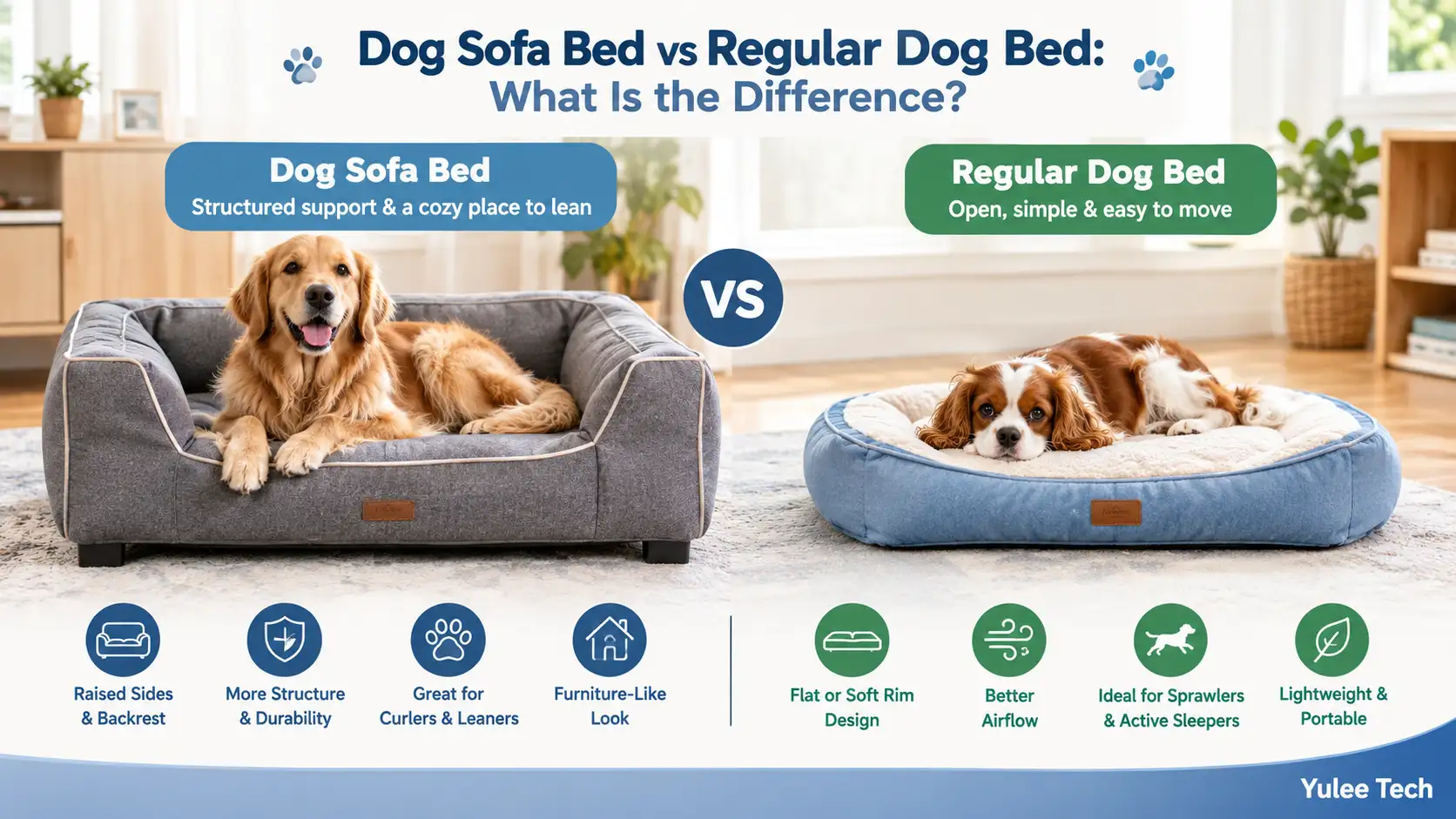
Walk into any pet store and two kinds of beds compete for the same floor space. One is the flat cushion most people grew up with, and the other is the structured dog sofa bed with a backrest and raised sides. Both give a dog a place to sleep, yet they behave very differently once a dog lies down on them, and the gap shows up in support, comfort, cleaning, and how long the bed lasts.
This guide explains exactly how the two styles differ. It starts with what each bed is, separates the shape of a bed from the support inside it, and then compares them factor by factor. It also matches each style to the dogs that suit it best, so the choice rests on how a dog actually sleeps and not only on how a bed looks.
What Is a Dog Sofa Bed?
A dog sofa bed is a bed built like a small piece of furniture. It has a sleeping surface in the center and raised sides, and often a raised back, so the dog can lean, rest its chin, or curl against an edge. The shape looks like a miniature couch, which explains the name.
Two construction styles share the label. A foam sofa bed uses shaped foam and bolsters with no hard parts, and it sits directly on the floor. A frame sofa bed adds a wooden or metal frame with short legs, which lifts the bed off the floor and gives it a firmer, more furniture-like structure. Both styles aim to give the dog something to lean against while keeping a defined sleeping space.
What Is a Regular Dog Bed?
A regular dog bed is a simpler sleeping surface with little or no structure around it. The most common forms are a flat cushion, a mat, a pillow bed, and a round donut bed with a soft rim. Some regular beds contain basic polyester fiberfill, and others contain thick orthopedic foam.
The defining feature is openness. A flat bed has no backrest and no tall sides, so the dog can enter from any direction and stretch out in any position. That freedom suits some dogs perfectly, and it explains why flat beds remain popular for crates, travel, and small spaces.
Shape vs Support: Two Different Questions
Many comparisons mix up two separate ideas. Shape describes the structure of the bed, such as flat, bolstered, or sofa-style. Support describes what is inside, such as loose fiberfill, soft foam, or dense orthopedic foam. A bed can have any shape with any level of support.
This distinction clears up a common confusion. A sofa bed is not automatically orthopedic, because a sofa-shaped bed can contain thin, soft filling. A flat bed is not automatically basic, because a flat mattress can contain thick, dense foam. A buyer who wants joint support should check what is inside the bed, and a buyer who wants a place to lean should check the shape.
1. Key Differences Between a Dog Sofa Bed and a Regular Dog Bed
1.1 Structure and Shape
A sofa bed wraps around the dog with a backrest and raised sides, and the structure keeps its form when the dog is not on it. A regular bed lies flat or has a soft rim, and many flat cushions change shape as the dog moves. The sofa bed creates a defined, contained space, while the regular bed offers an open surface.
1.2 Support and Foam
Support depends on the filling more than on the category. Basic fiberfill feels soft at first but compresses under body weight, especially under a heavy dog. Dense foam resists compression and spreads weight over a larger area, which relieves pressure on the hips, elbows, and shoulders. Sofa beds more often include layered or high-density foam because the structure needs materials that hold their shape, though cheaper sofa-style beds with soft filling exist as well.
1.3 Sleeping Style
Dogs fall into recognizable sleeping patterns. Dogs that curl up or rest their chins on something tend to use the bolsters and backrest of a sofa bed. Dogs that sprawl across the surface or switch positions often tend to prefer the open space of a flat bed. Watching a dog sleep for a few days gives a clearer answer than any product description.
1.4 Getting In and Out
A flat bed offers easy access from every side, which helps small dogs, puppies, and dogs with stiff joints. Raised sides can ask a dog to step over an edge, and a frame with legs raises the sleeping surface even further. Many sofa beds solve this with a lower front edge or a low-entry design, so a buyer for an older dog should look for that feature specifically.
1.5 Temperature and Airflow
Enclosing sides trap warmth, which many dogs enjoy in cold weather and some dogs dislike in warm weather. Flat beds usually allow more airflow around the body. A frame sofa bed with legs adds air circulation underneath, and it also keeps the bed away from cold floors and drafts.
1.6 Durability and Lifespan
Lifespan depends on construction quality, not on the category alone. A well-made flat bed with dense foam and a tough cover can last for years, and a poorly made sofa bed with soft filling can flatten quickly. As a general pattern, sofa beds more often use stronger seams, sturdier fabrics, and shape-holding foam, because the structure demands it. Cheap fiberfill beds of either style tend to lose shape fastest.
1.7 Cleaning and Care
Cleaning depends on removable covers and liners. A flat bed with a simple zip-off cover is the easiest style to wash. A sofa bed with bolsters, seams, and a frame can have more crevices, so a removable cover and a waterproof liner matter even more. Foam inside either bed should be spot cleaned and air dried, not machine washed.
1.8 Appearance and Placement
Sofa beds look like furniture, and owners often place them in living rooms because they match the room. Flat beds look more casual and tuck easily into corners, hallways, and crates. A bed that fits the room is a bed that stays in the spot where the dog wants to be, which is near the family.
1.9 Portability and Space
Flat beds are light and easy to move, fold, and pack for travel. Sofa beds are heavier and bulkier, and a frame model needs a dedicated spot. Anyone who moves a dog’s bed between rooms or takes it on trips should weigh this practical difference.
1.10 Price
Sofa beds usually cost more, because they use more material and more complex construction. Flat beds cover a wider range, from very cheap cushions to premium orthopedic mattresses. A low price often signals thin filling, so the better comparison is cost over time rather than cost on day one.
2. Which Dogs Suit Each Bed?
2.1 Senior and Arthritic Dogs
Older dogs benefit most from dense, supportive foam and easy access. Both styles can work. A low-entry sofa bed with orthopedic foam gives support and a place to rest the head, and a thick flat orthopedic mattress gives support with the lowest possible step-in. A bed supports comfort but does not treat a medical condition, so a dog that limps, struggles to stand, or shows persistent stiffness needs a veterinarian, not only a new bed.
2.2 Large and Giant Breeds
Heavy dogs press hard on any surface, so foam density and thickness decide the outcome. Cheap flat beds flatten quickly under a large dog. Sofa beds with dense foam and reinforced seams hold up better, but some lightly built frame models are not designed for very heavy dogs, so the weight rating deserves a check before buying.
2.3 Small and Anxious Dogs
Small dogs often like to burrow and nest, and anxious dogs often settle better when something surrounds them. The raised sides of a sofa bed create that contained feeling. A donut-style flat bed with a soft rim offers a similar effect for very small dogs.
2.4 Puppies
Puppies chew, have accidents, and outgrow beds. A washable flat bed with a waterproof liner and a tough cover is a practical choice during this stage. Buying for the dog’s adult size makes sense for larger breeds, though a very large bed can feel empty to a tiny puppy.
2.5 Hot Sleepers and Thick-Coated Dogs
Dogs with thick coats or a tendency to overheat often avoid enclosed beds. A flat bed with good airflow suits them better, and a frame sofa bed that lifts off the floor can also help because air moves underneath.
Side-by-Side Comparison
| Feature | Dog Sofa Bed | Regular Dog Bed |
|---|---|---|
| Shape | Raised sides, often a backrest | Flat, open, or a soft rim |
| Best for | Leaners, curlers, chin-resters | Sprawlers, position-changers |
| Support | Often denser foam, depends on the model | Ranges from thin fiberfill to thick orthopedic foam |
| Access | May need a step in, low-entry designs exist | Easy from every side |
| Warmth | Sides trap heat | More airflow |
| Durability | Often stronger build, depends on quality | Depends on foam and cover |
| Cleaning | Needs a removable cover and liner | Simple with a zip-off cover |
| Look | Furniture style | Casual |
| Portability | Heavier and bulkier | Light and easy to move |
| Price | Usually higher | Wide range |
Common Mistakes When Choosing Between the Two
- Choosing by appearance alone. A bed can look excellent online and use weak filling.
- Ignoring what is inside. Vague words like plush or ultra soft say nothing about support, so look for the type and density of the foam.
- Buying the wrong size. A dog should stretch out or curl up without hanging over the edge, and a sofa bed’s bolsters take up part of the outer size, so check the inner sleeping area.
- Skipping the removable cover. A cover that comes off for washing extends the life of any bed.
- Overlooking sleeping style. A sprawler in a bolstered bed or a curler on a thin flat mat will often leave for the floor.
Common Questions
Is a dog sofa bed better than a regular dog bed?
Neither wins in every case. A sofa bed suits dogs that lean, curl, or rest their chins, and a flat bed suits dogs that sprawl or need the easiest access. Support and build quality matter more than the category.
Do vets recommend dog sofa beds?
Veterinary guidance on bedding for older or mobility-compromised dogs focuses on supportive surfaces and easy access, not on one particular style. A veterinarian can advise on the right support for a specific dog.
Do dogs prefer hard or soft beds?
Most dogs like a surface that is supportive and comfortable at the same time. A bed that is too soft lets a heavy dog sink toward the floor, and a bed that is too firm may not suit a small, light dog. Watching how a dog settles on a trial bed answers the question quickly.
Is a sofa bed the same as an orthopedic bed?
No. Sofa describes the shape, and orthopedic describes the support. A sofa bed can be orthopedic when it contains dense, supportive foam, and a flat bed can be orthopedic too.
Does a dog need a bed at all?
Dogs can sleep almost anywhere, but a dedicated bed gives a dog a consistent, comfortable spot, keeps hair and dirt in one place, and protects furniture. Older dogs and heavy dogs benefit most from a supportive bed.
Match the Bed to the Way Your Dog Sleeps
The real difference between a dog sofa bed and a regular dog bed is how each one fits the dog using it. A sofa bed gives structure, a place to lean, and a furniture look, and a regular bed gives openness, airflow, and easy movement. Support inside the bed and the quality of the build matter more than the label on the box. Watching how a dog naturally sleeps, then choosing the shape and the foam that suit that habit, leads to a bed the dog actually uses.
Looking to Offer Both Styles?
Whatever style a customer prefers, the construction behind the bed decides how long it lasts. Brands and retailers that want to offer both can work with a dependable dog sofa bed manufacturer for foam, fabric, and size options, and the team at Yulee Tech can walk through samples and specifications on request.