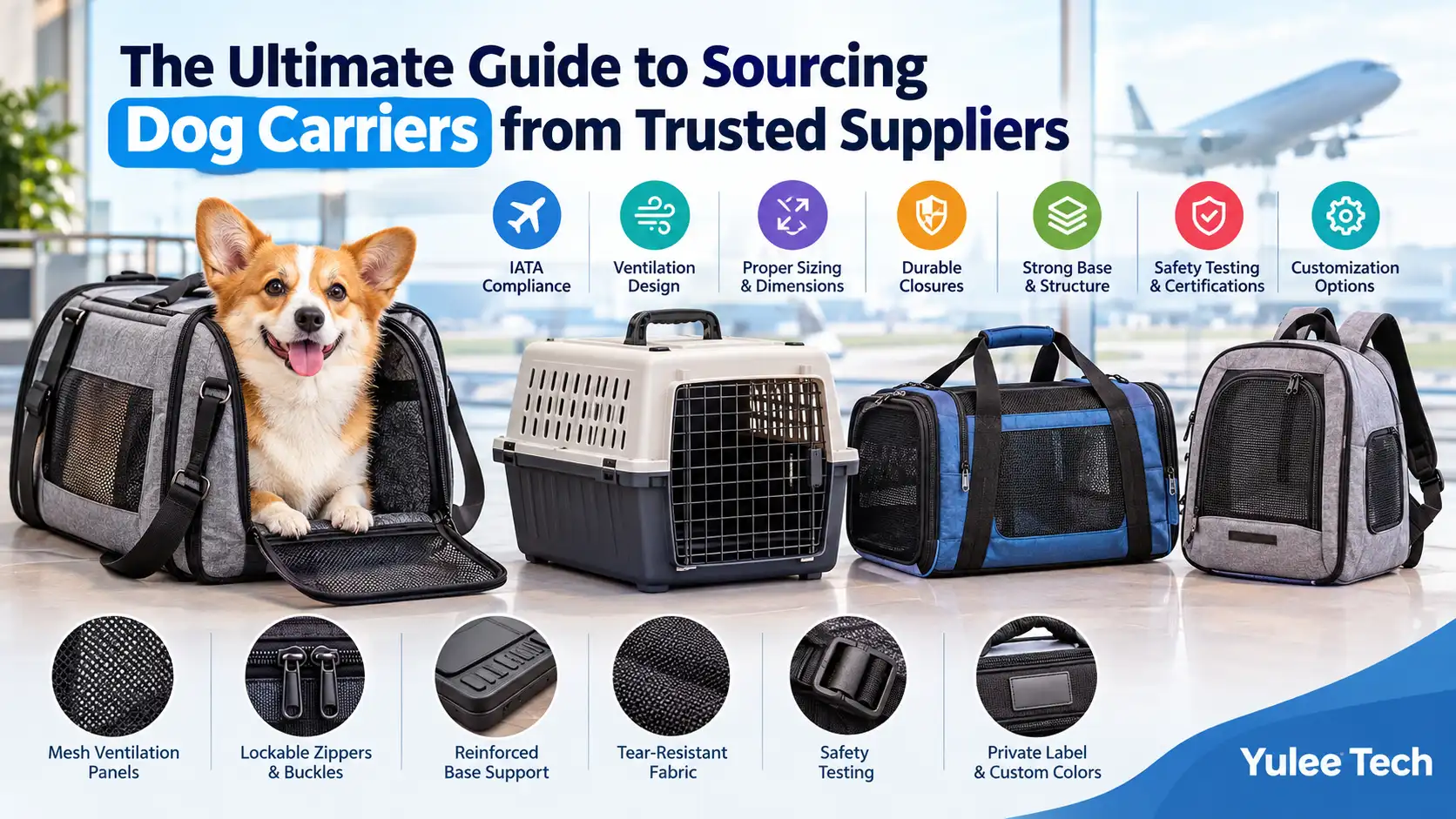
A dog carrier is not a simple accessory. It’s a safety-critical product that has to hold up under real weight, survive airline handling, and keep a dog secure during transit without the closure failing or the frame collapsing. Buyers who treat carrier sourcing the same way they’d source a food bowl or a toy often end up with returns, safety complaints, or a product that fails the exact moment it matters most. Working with a reliable dog carrier supplier means going deeper than color options and price per unit.
This guide walks through the specific technical and structural details buyers need to evaluate before committing to a bulk order, from airline compliance standards to closure security to what a sample inspection should actually check.
Understanding Airline (IATA) Compliance Standards for Carrier Construction
Many carrier purchases are driven by air travel, and airlines apply strict rules to what qualifies as a cabin-approved carrier versus one that’s only suitable for cargo hold or car travel. Cabin approval usually requires soft-sided construction that can compress slightly to fit under a seat, along with minimum dimensions that vary by airline. Cargo-hold carriers, by contrast, need rigid, vented construction rated for external handling. A buyer building a travel-focused product line needs to know which standard a given carrier design actually meets, since mislabeling a product as “airline approved” without verifying the construction against real airline rules creates a liability risk.
Ventilation Design – Mesh Panels, Airflow, and Heat Buildup
Ventilation isn’t a cosmetic feature on a dog carrier. It directly affects how safe the carrier is during warm weather or longer transit periods. Mesh panel placement matters more than mesh panel size, since airflow needs to move through the carrier rather than just exist on one side. Buyers should ask about mesh density as well, since overly fine mesh can restrict airflow just as much as too little ventilation altogether. Carriers intended for hot climates or extended travel should have cross-ventilation on at least two sides, not just a single front panel.
Breed and Size Charts – Matching Carrier Dimensions to Real-World Use
Generic small, medium, and large labels cause more sizing complaints in this category than almost any other pet product. A carrier needs enough interior height for a dog to stand without hunching and enough length for it to turn around comfortably, and these measurements shift significantly across breeds even within the same weight class. Buyers should request detailed interior dimension charts, not just exterior product measurements, since exterior size tells a buyer very little about how comfortable the carrier actually is for the dog inside it.
Zipper, Buckle, and Locking Mechanism Durability
Closure security is one of the most common failure points in lower-quality carriers, and it’s also the point where a manufacturing shortcut becomes a real safety issue. Double-zipper pulls with locking tabs prevent a dog from nosing a zipper open from the inside, while reinforced stitching at the closure seam prevents the fabric from tearing away from the zipper track under pressure. Buyers should specifically ask what closure hardware a supplier uses and whether that hardware has been tested under repeated stress, since a single weak zipper pull can undo an otherwise well-built carrier.
Base Structure and Load-Bearing Support
A carrier’s base absorbs the dog’s full weight for the entire duration of use, and a weak or unsupported base is one of the most common quality failures in bulk carrier orders. Rigid base inserts, whether plastic or reinforced board, distribute weight evenly and prevent the classic sagging-bottom problem that makes a carrier feel unstable when lifted. Buyers sourcing carriers for larger breeds or heavier dogs should confirm the base’s rated weight capacity directly with the supplier rather than assuming it matches the carrier’s advertised size category.
Material Testing for Chew, Scratch, and Tear Resistance
Fabric grade determines how long a carrier survives daily use, particularly around corners and closure points where a nervous or anxious dog is most likely to scratch or chew. Oxford cloth and ballistic nylon are common choices for exterior shells because of their tear resistance, while interior lining needs its own durability standard since claws often do more damage from the inside than the outside. Buyers should ask suppliers directly what denier rating their fabric carries and whether interior panels use a separate, more durable lining than the exterior shell.
Certifications and Safety Testing Documentation to Request
A trustworthy supplier should be able to provide documentation beyond a verbal assurance of quality. This includes structural load testing that confirms the carrier holds its rated weight without base failure, and closure security testing that confirms zippers and buckles resist a set amount of internal pressure without releasing. Buyers should treat the availability of this documentation as a filter, since a supplier unwilling or unable to produce testing records is asking a buyer to take safety claims on faith alone.
Customization Options – Sizing Tiers, Colors, and Private Label Branding
Beyond core construction, most suppliers offer some level of customization for buyers building a private-label carrier line. This typically includes color options for both the exterior shell and interior lining, custom mesh panel colors, and private-label branding through embroidered logos, woven tags, or branded zipper pulls. Buyers planning a multi-tier product line should also confirm whether a supplier can produce consistent sizing tiers across a full range, from small breed carriers up through larger, reinforced designs, without shifting fabric grade or construction quality between sizes.
Sample Evaluation – What to Physically Check Before Bulk Ordering
No spec sheet fully replaces handling an actual sample. Buyers should test the zipper pull under firm pressure to check for smooth operation and secure locking, inspect stitching at every stress point including the base seams and closure edges, and check the fold or collapse mechanism if the carrier is designed to fold flat for storage. A sample that shows loose threads, uneven stitching, or a stiff, difficult zipper is a strong signal of what an entire bulk order will look like once it arrives.
Packaging and Shipping Considerations for Bulky Carrier Units
Carriers take up more shipping volume than most pet accessories, particularly rigid or semi-rigid designs that can’t compress for transit. Suppliers experienced in bulk carrier shipping typically offer compression packaging for soft-sided models and volume-optimized container loading for rigid designs, both of which reduce per-unit shipping cost significantly on large orders. Buyers should ask a supplier directly how they package mixed orders of soft-sided and rigid carriers together, since inefficient packing on bulky items erodes margin fast on high-volume shipments.
What Separates a Reliable Carrier Partner from the Rest
Unlike many pet accessories, a carrier failure has a direct and immediate safety consequence, whether that’s a zipper releasing mid-transit or a base collapsing under weight. That’s what makes the sourcing process for this category different from sourcing a bed or a bowl. Suppliers who can speak specifically to closure testing, base load ratings, and ventilation design, rather than general claims about “durability” or “quality,” are the ones worth building a long-term relationship with.
Ready to Source With Confidence?
Yulee Tech manufactures dog carriers built around the exact standards covered in this guide, from reinforced closures to tested base construction. Reach out to discuss samples, sizing tiers, and your next bulk order.