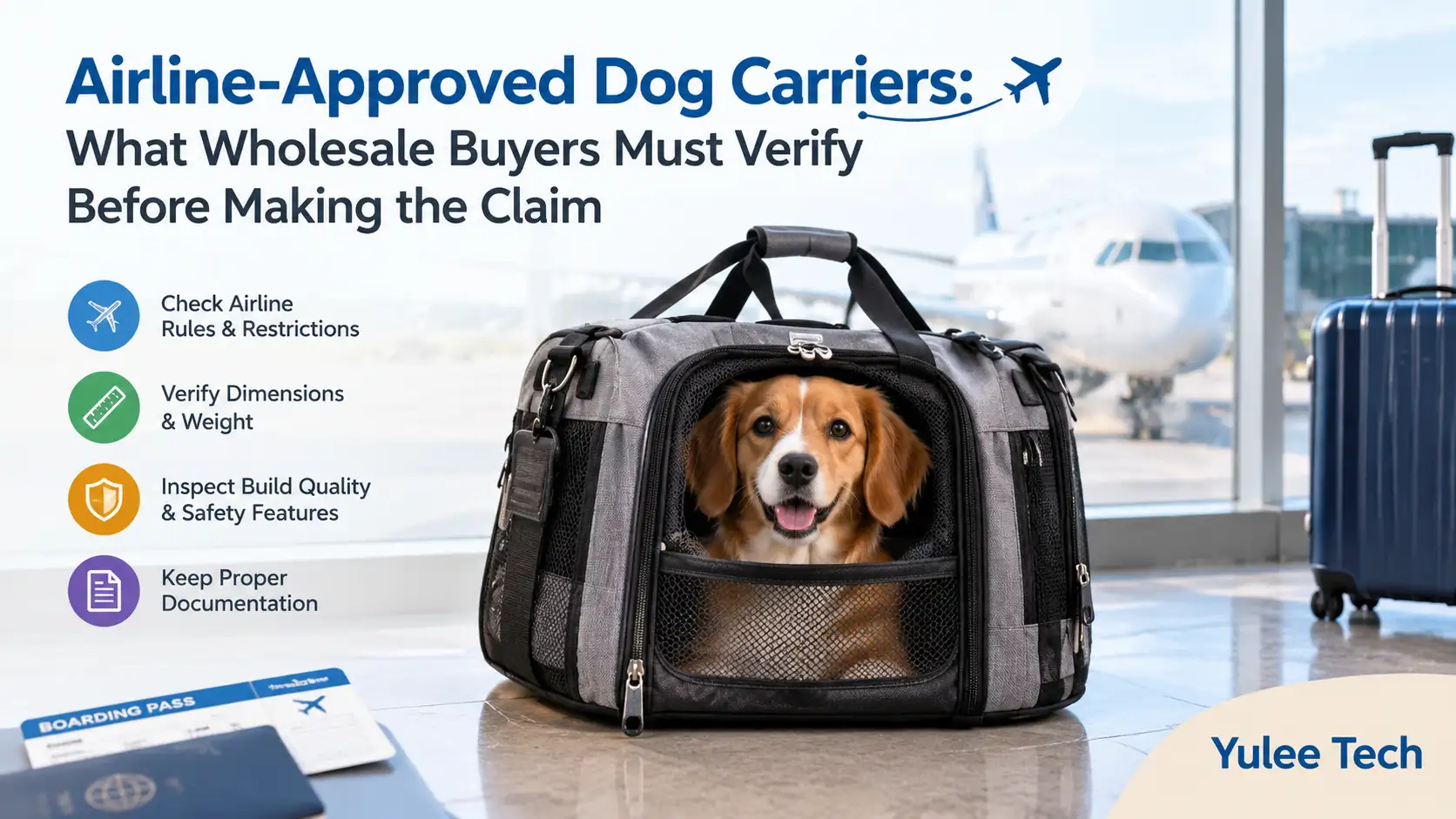
The phrase “airline approved” appears on thousands of dog carrier listings, and it is one of the most searched and most misunderstood claims in the category. It sounds like a certification, yet no authority issues one. No test exists for it, no official list names the carriers that pass, and no carrier arrives pre-cleared for every flight. A buyer who prints the phrase on packaging or a product page takes on the risk that comes with it, from customer complaints and marketplace takedowns to false-advertising exposure when a dog is refused at the gate.
That risk does not mean a brand should avoid the travel market. It means the claim has to rest on evidence. A qualified dog carrier supplier can supply dimensions, construction details, and material information, but the buyer who sells the product decides what the listing says and has to be able to defend it. Airline wording is only one layer of the decision, since closure security, base strength, and ventilation all shape whether a carrier is safe to sell in the first place, which is why it helps to understand the wider process of sourcing dog carriers from trusted suppliers before any travel claim goes on a listing. This guide explains who actually sets the rules, how cabin carriers and cargo kennels differ, what to verify on a sample, which documents to keep, and how to word a claim so that it stays accurate when a customer, a retailer, or a marketplace asks for proof.
1. What “Airline Approved” Really Means and What It Does Not
In practice, “airline approved” is a manufacturer’s description of a shape. It says that a carrier is built in a size and style that commonly fits beneath an airplane seat. It does not say that any specific airline has inspected the product, and it does not promise that a gate agent will accept it on a given day.
Three facts explain why the label cannot work as a guarantee.
- No certifying body exists. The International Air Transport Association publishes guidance and container standards for animal transport, and it states that it does not certify, approve, endorse, or sell any particular pet container brand or model.
- Airlines decide for themselves. Each operating airline sets the dimensions, weight rules, and carrier styles it accepts, and those rules differ between airlines, aircraft types, cabins, and routes.
- Acceptance happens at the airport. Staff assess the carrier, the dog, and the itinerary on the day, so even a carrier that fits one flight can be refused on another.
For a wholesale buyer, the practical meaning is simple. “Airline approved” is a claim, not a status, and the buyer must be able to show what the claim rests on.
2. Who Sets the Rules: IATA Guidance Versus the Operating Airline
Two layers of rules apply, and confusing them is the most common source of mistakes.
IATA guidance provides the general standards for animal containers. For dogs and cats traveling in the aircraft hold, its container requirement covers construction, size, ventilation, doors, fasteners, flooring, and labeling. For pets traveling in the passenger cabin, IATA publishes separate traveler guidance, and its container rules are more flexible. Many airlines follow IATA as a baseline.
The operating airline adds its own limits on top. It decides the maximum carrier dimensions under its seats, whether it accepts a dog in the cabin at all, how many pets it allows per flight, and which hardware or materials it requires for cargo kennels. An airline can be stricter than IATA, and it can refuse a container that meets the general standard.
The aircraft matters as well. Under-seat space changes between aircraft types and between seats on the same aircraft, and bulkhead rows or seats with equipment boxes can offer less room. A policy page may list one size, while the actual space under a particular seat is smaller. That gap is why published guidance tells travelers to confirm requirements directly with the airline before buying tickets, and why a brand should never present one carrier as suitable for every flight.
3. Three Ways a Dog Travels: Cabin, Checked Baggage, and Cargo
The right product depends on how the dog travels, so a listing should state which travel mode the product is designed for. The table below summarizes the main differences.
| Travel Mode | Typical Container | Main Design Concern | Who Decides Acceptance |
|---|---|---|---|
| In the cabin | Soft-sided carrier that fits under the seat | Under-seat fit, ventilation, comfort, closure security | The operating airline and its gate staff |
| Checked baggage | Rigid kennel | Construction, size, fasteners, ventilation | The operating airline, following IATA guidance |
| Manifest cargo | Rigid kennel | The same as checked baggage, plus handling and routing | The operating airline or cargo handler |
A soft-sided cabin carrier and a rigid cargo kennel are different products with different checklists. A kennel that meets cargo standards can be unsuitable for the cabin, and a soft carrier cannot protect a dog in the hold. A brand that sells both should keep their claims, size charts, and instructions separate, so that a customer never confuses one product with the other.
4. Verifying a Cabin Carrier
Most “airline approved” listings describe soft-sided cabin carriers, so this category deserves the closest look. Each point below can be checked on a physical sample.
4.1 Under-Seat Dimensions
Published guidance often cites under-seat sizes in the range of roughly 17 x 11 x 8 inches up to about 18 x 12 x 10 inches, but these figures are not universal. Height is usually the dimension that fails, because seat frames and equipment limit vertical space even when length and width look generous.
Check three sets of numbers for every model:
- The external envelope. This is the length, width, and height of the closed carrier, measured in every direction.
- The usable interior space. This is what the dog actually has, after padding, frame inserts, and seams reduce the interior.
- The loaded condition. A carrier can fit when empty and bulge, sag, or bow once a dog stands in it, so measure again under load.
A size chart that lists only small, medium, and large is not enough. Ask for exact dimensions, and record the tolerance, since sewing always creates small variations between units.
4.2 Combined Weight and Empty Carrier Weight
Many airlines apply a combined weight limit that covers the dog and the carrier together. Published guidance often cites a figure of around 20 pounds for in-cabin travel, although some airlines focus more on whether the carrier fits under the seat than on a strict cutoff. Because limits vary, the empty weight of the carrier matters. A heavy carrier leaves little allowance for the dog.
Weigh the empty carrier, weigh it with the dog’s typical weight, and list the empty weight on the product page. A listing that claims a maximum dog weight without mentioning the carrier’s own weight invites returns.
4.3 Soft-Sided Structure and Shape Recovery
A cabin carrier has to compress slightly to slide under a seat, and it also has to protect the dog’s space. Soft does not mean shapeless. Flexible stays or a spring-type frame in the rear panel allow the carrier to squeeze under tight seats and then spring back. A semi-rigid base panel keeps the floor flat when the carrier is lifted, and a weak base turns the carrier into a hammock that causes the dog to slide.
Test shape recovery by compressing the sample and watching whether it returns to its form. Check the top panel as well, since a soft roof can fold down onto the dog.
4.4 Ventilation and Compression
Ventilation is a safety feature, and it can change under compression. IATA guidance notes that soft-sided containers can compress when pushed under a seat, and that compressed ventilation openings can reduce airflow and lead to heat buildup. A design that looks well ventilated when empty can lose airflow once it is squeezed.
Review the mesh layout carefully. Mesh on several sides gives better cross-flow than a single panel, and airflow should still work when the carrier is loaded and compressed. The mesh itself must resist claws, so check the weave, the stitching around the edges, and the reinforcement at the corners. A large mesh area that is poorly supported can weaken the structure, and a very small mesh area can trap heat.
4.5 Escape-Resistant Closures
A frightened dog pushes, scratches, and noses at zippers. Check the closure path and the hardware:
- Self-locking or lockable zipper sliders
- Zipper pulls that clip together or to a fixed point
- Reinforced stitching at the ends of the zipper tracks
- Interior safety tether anchors with bar-tack stitching
- Mesh-to-fabric seams that cannot tear away
Describe these as features the buyer specified and checked. Never describe them as proof that no escape is possible.
4.6 Leak-Resistant Base and Removable Pad
Accidents happen during travel, and a base that leaks into the cabin floor or a passenger’s bag creates a bad experience. A coated or lined base, a tray-style insert, or a welded liner each offers a different balance of weight, cost, and ease of cleaning. Stitched seams in a waterproof layer create tiny holes, so ask how the seams in the base are sealed.
A removable pad makes a practical cleaning promise possible. A fixed pad makes cleaning harder, so the listing should not claim easy cleaning in that case.
4.7 Expandable Designs
Expandable carriers add room in the terminal, and the expansion panels must be fully closed during the flight. List the compressed and expanded dimensions separately, and make clear that only the closed dimensions apply to the under-seat check. An expanded size that appears in the headline can mislead a buyer who then finds the carrier is too large to board.
5. Verifying a Cargo Kennel
A rigid kennel for the hold follows a stricter standard. According to published summaries of the current IATA container requirement for dogs and cats, the main elements include the following.
| Element | What the Standard Describes | What a Buyer Should Verify |
|---|---|---|
| Materials | Rigid plastic, metal, fiberglass, solid wood, or plywood, built appropriately; all-wire containers are not suitable | The material and thickness of every part |
| Floor | Solid and leak-proof | No holes, grates, or perforations in the floor |
| Fasteners | Top and bottom shells securely bolted; plastic clips cannot be the only fasteners | Metal nuts and bolts supplied or specified in every hole |
| Door | Forms the whole of one end, with strong metal hinges and locking pins | Door material, pin engagement, hinge strength |
| Ventilation | Total ventilated area of at least 16 percent of the four sides, with openings sized so noses and paws cannot protrude | The ventilation percentage and the opening sizes |
| Wheels | Removed or rendered inoperable | Wheels that detach, or a design without wheels |
| Spacers and handles | Spacers keep other freight from blocking airflow, and handles allow safe handling | Their presence and position |
| Food and water | A water container attached inside with outside access | Attached dishes that fill without opening the door |
| Labels | Live-animal and orientation labels required | Space and instructions for the labels |
These items come from published summaries, and the standard is updated regularly, so buyers should check the current edition of the container requirement and the target airline’s own rules before finalizing a specification. Airlines can be stricter, for example by requiring metal hardware or ventilation on specific sides.
A common rejection involves a floor with holes. Some popular plastic kennels ship with a perforated floor pan that works well at home and in the car but fails for air travel. A brand that sells a kennel for flying should confirm the floor, the fasteners, and the hardware before using any travel wording.
6. Measurements and Interior Space
Size is the second most common cause of refusals, and it creates a design tension that every brand has to handle honestly. Published guidance says a carrier should be big enough for a dog to sit, stand, lie down, and turn around comfortably, and also small enough to fit under the seat. For a small dog with room to spare, both hold. For a dog near the upper limit, they pull against each other.
For cargo kennels, IATA provides a sizing method based on four measurements: the length from nose to base of tail, the height from floor to elbow, the width across the shoulders, and the standing height to the top of the head or ears. The minimum internal length equals the nose-to-tail length plus half the elbow height. The minimum width equals twice the shoulder width. The minimum height equals the standing height plus the bedding. Flat-faced breeds need a container about 10 percent larger.
Several practical points follow:
- Quote internal dimensions. Outside measurements say little about the dog’s real space.
- Count the bedding. Any pad or liner reduces the interior height. A retailer that sells separate dog beds or liners for use inside a carrier should state the thickness, so customers can account for it.
- Help owners measure. Include a short guide that explains how to measure a dog and how to compare the numbers with the carrier.
- Be honest about limits. If a carrier is built for dogs up to a size, say so, and do not suggest it suits a larger dog.
7. Build a Verification File Before You Launch
A verification file is a folder of evidence that supports every statement on a listing. It protects the brand when a retailer, a marketplace, or a customer asks for proof, and it keeps the sourcing team honest. A complete file includes:
- Rule sources. The official IATA pages and the operating airline’s pet policy pages for each airline named in the listing, with the date each was checked.
- A controlled drawing. The approved external and internal dimensions, with tolerances.
- A bill of materials. Fabrics, mesh, liner, base, zippers, frame stays, and hardware, with specifications.
- Loaded measurements. Dimensions of the closed carrier, both empty and under a typical load, with photos.
- A sample review record. The reviewer’s name, the date, the tools used, and what was observed.
- Material documents. Reports for fabric, mesh, lining, plastic parts, and packaging, scoped to the destination market, for example REACH for the European Union or Proposition 65 for California.
- A test plan. The method, the sample count, and the acceptance criteria for any load, zipper, drop, or waterproofing test, agreed before the work begins.
- Approved claim wording. The exact sentences allowed on the listing, the packaging, and customer service scripts.
Keep the file current. When the pattern, the mesh coverage, the base, or the frame changes, the review has to happen again, because these changes affect ventilation, security, and the loaded size.
8. Sample Validation: What to Measure and Record
A sample answers questions that photos cannot. Run the same routine on every sample and write down the results.
- Measure the closed carrier in length, width, and height, and compare the numbers with the drawing.
- Load the carrier with a weight that matches the stated maximum, and measure again.
- Compress the carrier gently, as an under-seat fit would, and check whether it recovers.
- Inspect the mesh for coverage, edge stitching, and strength at the corners.
- Operate every zipper repeatedly, and check the sliders, the locks, and the pull attachments.
- Lift the carrier by every handle and strap, and watch the base for sagging.
- Check the base and pad for leak resistance, and remove and replace the pad.
- Weigh the empty carrier and record the number.
A sample that passes once does not prove the whole order. Compare bulk units with the approved sample, which becomes the standard for the production run.
9. Claim Wording: Risky Statements and Safer Alternatives
Wording turns evidence into a promise, so choose it carefully. The table below shows common risky statements and safer replacements.
| Risky Statement | Safer Alternative | Why It Is Safer |
|---|---|---|
| Airline approved | Designed for in-cabin pet travel | It describes the intent without claiming any airline accepts it |
| Fits all airlines | Check your airline’s current under-seat size before travel | It respects the differences between airlines |
| IATA approved | Use only when exact supporting evidence exists | IATA does not approve individual products |
| Guaranteed to fit | Sized for common under-seat requirements | It avoids a universal promise |
| 100 percent leak proof | Leak-resistant base | It is easier to support with the real construction |
| Fits any dog up to 20 lb | Suitable for dogs up to the listed size; check combined weight with your airline | It reminds the customer that weight limits vary |
Add a short notice to the packaging, the product page, and the manual. The notice should tell customers that airline rules change and that they must confirm size and carrier requirements with their airline before booking. A listing may name a specific airline and date only when the evidence supports it, for example “dimensions checked against [airline name] policy as of [date].”
10. Instructions That Reduce Returns
Many returns come from owners who bought the right carrier and used it the wrong way. A short instruction card, a page in the manual, or a link on the product page can prevent most of them. Useful content includes the following.
- Measure first. Show how to measure the dog and how to compare the numbers with the carrier’s interior size.
- Call the airline. Tell owners to confirm the current under-seat size, the pet fee, and the number of pets allowed on the flight.
- Weigh together. Suggest weighing the dog inside the carrier, since many limits apply to the combined weight.
- Acclimate early. Recommend leaving the carrier open at home for weeks, with a familiar blanket and a favorite item inside, and feeding treats in it so that it becomes a safe place. Retailers that also stock dog toys can place a small toy or chew next to the carrier display, since a familiar toy often helps a dog settle.
- Keep the dog inside. Explain that airlines generally require the dog to stay in the carrier for the whole flight, so the carrier has to be comfortable for the full trip.
- Ask a vet. Suggest a veterinary check before flying, and advise against giving sedatives without veterinary advice.
These instructions protect the customer and the brand, and they show that the product was designed with the real journey in mind.
11. Production Consistency: Tolerances, Golden Samples, and Pre-Shipment Checks
A good sample is only the start. The product that arrives in the warehouse has to match it, and sewn products vary naturally. Control that variation with these steps.
- Approve a golden sample. Sign it, keep it, and treat it as the reference for every production lot.
- Set measurement tolerances. Agree on the allowed variation in length, width, and height, since a carrier that grows by an inch can fail an under-seat check.
- Specify the sewing standards. State the stitch density, the thread type, and the reinforcement points.
- Inspect before shipping. Use a pre-shipment inspection that checks dimensions, zippers, mesh, stitching, and labels on a random sample of cartons.
- Record defects. Use a defect classification chart, and agree on the acceptable limit for each defect class.
Consistency across lots keeps the verification file true. A claim made on the sample means little if bulk units differ.
12. Common Mistakes to Avoid
- Printing “airline approved” without any supporting file.
- Treating one airline’s policy as the rule for all airlines.
- Quoting external dimensions and ignoring interior space and bedding.
- Forgetting that weight limits often include the carrier.
- Selling a kennel with a perforated floor or plastic-only fasteners as suitable for air cargo.
- Showing an expanded size in the headline when only the closed size matters for boarding.
- Changing the pattern or mesh layout without repeating the review.
- Relying on the supplier’s verbal assurance in place of documents.
13. Questions to Ask the Supplier Before Approving a Sample
- Which carrier styles in your range are designed for the cabin, and which for the hold?
- What are the exact external and internal dimensions of each size, and what is the tolerance?
- What does the carrier weigh when empty?
- How does the structure recover after compression, and which parts provide the shape?
- Where is the mesh, how much of the surface does it cover, and how is it reinforced?
- Which closure hardware is used, and has it been tested under repeated stress?
- How is the base sealed against leaks, and can the pad be removed?
- Which material documents exist for the fabric, mesh, lining, and plastic parts?
- Can you provide a golden sample and a pre-shipment inspection report for each lot?
- What wording do you recommend for the product page, and what evidence supports it?
A supplier that answers these questions clearly, with documents and measurements, has thought about the product beyond the photo.
A Claim Is Only as Strong as Its Evidence
“Airline approved” will keep appearing on listings because it helps products rank and sell. The brands that gain from it are the ones that can defend it. That means knowing who sets the rules, separating cabin carriers from cargo kennels, measuring the sample in loaded and compressed condition, keeping a verification file, and choosing wording that describes the product honestly. When a customer asks why a carrier was refused, or a retailer asks for proof, a brand with a file and a careful claim has a real answer.
Build the Claim on Documents
Evidence is easier to gather when the product information is clear from the start. Yulee Tech provides dog carriers and can share dimensions, construction details, and material information for each model, so a buyer can assemble a verification file before publishing any airline-related claim.